
Choosing Your First Mahjong Set
Whether you are a beginner or advanced players here are great tips for finding the perfect mahjong set for you!

How Do I Choose the Right Mahjong Set?
A Mahjong Instructor's Buying Guide
If you're new to American Mahjong, shopping for your first mahjong set can be overwhelming. There are hundreds of options, ranging from inexpensive traditional sets to gorgeous designer tiles that cost hundreds of dollars. With so many colors, patterns, sizes, and accessories to choose from, how do you know which one is right for you?
As a mahjong instructor teaching beginner classes throughout the Twin Cities, I get this question from my students all the time. And after teaching beginners, playing with different sets, and seeing what works (and what doesn't), I've developed some pretty strong opinions about what makes a good mahjong set.
Here's my biggest piece of advice: The prettiest mahjong set isn't always the best one to play with.
Some sets look absolutely beautiful in photos but turn out to be frustrating to use. Others are surprisingly affordable and have everything you need for years of enjoyable games.
Whether you're shopping for your very first set, looking for a gift, or thinking about upgrading to something a little fancier, here's what I recommend.
1. Make Sure You're Buying an American Mahjong Set
This is the most important thing to check before buying anything. There are several variations of mahjong played around the world, and not all mahjong sets include the same tiles.If you're learning American Mahjong, you need a set designed for that version of the game.
How Many Tiles Should an American Mahjong Set Have?
Look for a set with at least 152 tiles, including 8 jokers. Jokers are an essential part of American Mahjong, and you don't want to discover that your beautiful new set doesn't have any!
Many sets sold online are designed for Chinese Mahjong, which doesn't use jokers in its traditional forms. If the description doesn't mention jokers, that's a red flag.
Don't Forget the Accessories
Another important distinction is whether you're buying a complete mahjong set or just a set of tiles.
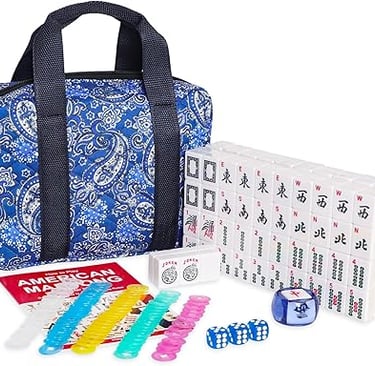
A complete set typically includes:
Mahjong tiles
Four racks, ideally with pushers
A carrying bag or case
Most sets do not include a mahjong mat, so plan to purchase that separately.
If you're just getting started, I recommend buying a complete set. It's usually more economical, and you'll have everything you need to start playing, other than your mat and current American Mahjong card.
2. Choose Mahjong Tiles That Are Easy to Read
This might be my number one piece of advice when it comes to selecting the actual tiles. Make sure the numbers and designs are clear and easy to recognize.
When you're learning mahjong, you're already concentrating on your hand, remembering the rules, and figuring out your next move. The last thing you need is to struggle to identify the tiles.
Look for Clear, Readable Numbers
Some mahjong sets have fancy decorative fonts that look pretty but are surprisingly hard to read. I've seen tiles where the numbers are so small or stylized that it's difficult to tell a 3 from an 8.
Imagine trying to make a quick decision during a game when you can't immediately recognize the tile you're holding! I recommend looking closely at product photos before you purchase. Zoom in on the numbers and ask yourself whether you'd be able to recognize them instantly.
If you have to study the photo to figure out what number you're looking at, keep shopping.
Make Sure the Suits Are Easy to Recognize
In American Mahjong, there are three suits: bams, dots, and cracks.
Traditional mahjong tiles have recognizable designs for each suit, but some of the newer themed sets get pretty creative. And while I love a beautiful mahjong set, there's a downside to designs that stray too far from tradition.
Imagine inviting a new player to join your game. Every few turns, they have to stop and ask, "Is this a bam or a dot?" It slows down the game, interrupts everyone's concentration, and can be frustrating for the new player.
When I'm recommending a set for beginners, I encourage them to choose tiles that someone seeing the set for the first time can understand without constantly asking questions.
Even the Flower Tiles Matter!
Here's something you might not think about when you're shopping.
Traditional mahjong flower tiles often have intricate designs that don't immediately look like flowers. For beginners, that can make learning to recognize them a little more challenging.
I particularly like sets that have flowers that actually look like flowers! It's a small detail, but when you're learning an unfamiliar game, little things like that can make a difference.
3. Pay Attention to Mahjong Tile Size
Mahjong tiles come in several sizes, and bigger isn't necessarily better.
A standard-size mahjong tile is approximately:
1.2 inches tall
0.9 inches wide
0.5 inches deep
For most beginners, this is an excellent size. Standard tiles are comfortable to handle, fit most standard racks, and are reasonably easy to transport.
What About Smaller Mahjong Tiles?
Smaller tiles are typically designed for travel sets. They're compact and easier to pack, but I wouldn't generally recommend them as your primary mahjong set. If you're purchasing your first set for regular games with friends, stick with standard-size tiles.
Are Larger Mahjong Tiles Better?
Larger tiles are often found in premium mahjong sets. They tend to have a more substantial feel and may feature multiple layers of colorful material that create beautiful designs. They can also have larger numbers and symbols, which makes them easier to read.
For experienced players who enjoy the feel and appearance of luxury tiles, that can be a wonderful upgrade.
But there's a trade-off: Large tiles are heavier and may not fit standard mahjong racks. I learned just how important that can be from my own mom.
My Mom's Mahjong Set: A Lesson in Why Bigger Isn't Always Better
My mom purchased a mahjong set from Sam's Club because it seemed like such a great deal. The tiles were beautiful - she loves bright colors. Unfortunately, the set turned out to be much less practical than she'd expected.
First, the tiles were so large that the entire set was incredibly heavy. My mom wants to be able to take her mahjong set to her clubhouse to play with friends, but carrying it around became a real challenge. Plus they were so thick that she couldn’t use them with a standard rack.
And then there were the numbers. The decorative font was so fancy that the tiny numbers were nearly impossible to read.
So even though it seems like a bargain, I generally recommend avoiding the oversized sets I've seen sold at Costco and Sam's Club.
If you're considering an oversized set, think carefully about where you'll be playing, how often you'll need to carry it, and whether your racks will accommodate the tiles.
4. Look for Engraved Tile Designs, Not Just Painted Ones
One detail I always tell my students to check is how the designs are applied to the tiles. Look for tiles with engraved designs rather than designs that are simply painted onto the surface.
Mahjong tiles get handled a lot. They're shuffled, stacked, picked up, discarded, and moved around the table for hours. Engraved tiles have designs recessed into the surface, which generally makes them more durable. Over time, surface-painted designs can wear off, especially on inexpensive sets.
Why I Don't Recommend the Hobby Lobby Mahjong Sets
I've seen some very inexpensive mahjong sets sold at Hobby Lobby. And while the price can be tempting, I generally don't recommend them. In my experience, the designs tend to be a little blurry, and the paint can rub off.
A mahjong set should last through hundreds of games. Saving a few dollars upfront isn't necessarily worthwhile if the tiles become difficult to read or start looking worn.
You don't need to spend a fortune to get a good set, but quality matters.
5. How Much Should You Spend on a Mahjong Set?
Here's some good news: You absolutely do not need to spend hundreds of dollars to start playing mahjong. In fact, I generally encourage beginners to start with an affordable, practical set. Make sure you like this game before investing hundreds of dollars in a gorgeous set.
Budget-Friendly Mahjong Sets: Under $100
You can find a good complete American Mahjong set for under $100.
Amazon has quite a few affordable options, and many include the tiles, racks, and a carrying bag. For someone just starting out, that's usually everything you need, except for a mat and your current playing card.
If you're purchasing tiles only, you can often find a reasonably priced set for around $40. Just remember that you'll need to purchase the racks and carrying bag separately. Sometimes a complete set ends up being a better value.
My Recommendations for Affordable Mahjong Sets
Here are two types of sets I like to recommend to beginning players.
A Traditional American Mahjong Set
If you're looking for something practical and reasonably priced, this is a great place to start. This option includes traditional-style tiles, racks, and a carrying bag. View the Traditional Mahjong Set on Amazon I like traditional tile designs because they make it easier for beginners to recognize each suit and become comfortable with the game.
A Prettier Set With Easy-to-Recognize Flowers
If you're willing to spend a little more, I also like this option. View the Decorative Mahjong Set on Amazon
The tiles have a prettier design, and one of my favorite features is that the flower tiles actually look like flowers! That may sound like a small thing, but it's especially helpful for beginners who are still learning to identify all the different tiles.
It's a nice balance between appearance and practicality.
6. Should You Buy an Expensive Designer Mahjong Set?
If you've spent any time browsing mahjong sets online, you've probably noticed some absolutely gorgeous designer options.
They come in beautiful colors, interesting patterns, layered materials, and creative themes. Some are almost like little works of art!
And while I don't think a beginner needs an expensive designer set, I completely understand why experienced players fall in love with them.
Why Experienced Players May Want to Upgrade
As players become more experienced, their priorities often change.
When you're first learning, you're focused on understanding the game. You want tiles that are easy to read, comfortable to handle, and reasonably priced. But once you're playing regularly, you may want something a little more special.
Premium mahjong sets often feature:
Larger tiles with a substantial, satisfying feel
Beautiful colors and layered designs
Unique patterns and more decorative details
Larger numbers and symbols that may be easier to see
A more luxurious overall playing experience
There's something really enjoyable about playing with a beautiful, substantial set of tiles.
For someone who plays mahjong frequently, upgrading can be a fun way to celebrate a hobby they've grown to love.
Are Designer Mahjong Sets Worth the Money?
That really depends on what matters to you.
An expensive set isn't going to make you a better mahjong player, and it doesn't necessarily function better than an affordable one.
What you're often paying for is the appearance, materials, design, and overall experience of playing with the tiles. And there's nothing wrong with that!
If you play several times a week and love having a beautiful set, it may be worth the investment.
But I wouldn't encourage someone to spend hundreds of dollars on their first set before they've even learned how to play. My advice is to start with a good-quality, affordable set and upgrade when you know what you like. By then, you'll have a much better sense of your preferences for tile size, weight, colors, and designs.
7. Think About Where and How You'll Be Playing
One of the things people often overlook when shopping for a mahjong set is how they actually plan to use it.
Are you going to host mahjong games at your house? Bring your set to a friend's home? Take it to a clubhouse or community center every week?
Your answers should influence which set you purchase.
If You'll Be Carrying Your Set to Games
Weight matters!
Remember my mom's oversized Sam's Club set? It seemed wonderful until she had to carry it to her clubhouse.
If you're frequently transporting your mahjong set, look for:
Standard-size tiles rather than oversized ones
A sturdy carrying bag with comfortable handles
A case that holds the tiles and accessories securely
Racks that fit the tiles properly
A manageable overall weight
A beautiful set isn't nearly as enjoyable if you dread carrying it to your weekly game.
If You'll Mostly Play at Home
If your set will stay at home, you have more flexibility. You might prefer larger, more luxurious tiles that feel substantial in your hands.
You may also be more willing to invest in a decorative set because you don't have to worry about transporting it and it getting bashed around in transport
Just remember that oversized tiles may require larger racks, so make sure your accessories are compatible.
If You'll Be Playing With Beginners
This is where I really encourage practicality over appearance. If you're planning to host games with people who are still learning, choose tiles with clear numbers and recognizable suits.
When you're introducing someone to mahjong, you want them concentrating on how to play, not trying to figure out what the tiles represent. Even if you love a unique themed set, consider whether it will be easy for your guests to use.
8. My Mahjong Set Buying Checklist
Before you purchase a mahjong set, here's what I'd encourage you to check.
American Mahjong compatibility: Does it include at least 152 tiles, including 8 jokers?
Tile size: Are the tiles standard size, approximately 1.2" × 0.9" × 0.5", or are they larger or smaller?
Readable numbers: Can you easily identify the numbers without squinting or studying the font?
Recognizable suits: Can someone unfamiliar with the set quickly distinguish bams, dots, and cracks?
Engraved designs: Are the designs engraved into the tiles rather than simply painted on the surface?
Tile durability: Do the materials and designs look like they'll hold up to regular use?
Included accessories: Does the set come with racks, pushers, and a carrying bag, or will you need to purchase those separately?
Weight: Will the set be easy to carry if you regularly play away from home?
Price: Are you getting good value for what you're spending?
Personal style: Do you love the way the tiles look? After all, mahjong should be fun!
If a set checks most of these boxes, you're probably making a good choice.
9. My Final Advice: Choose a Set You'll Enjoy Playing With
Mahjong is such a wonderful game because it brings people together. Whether you're playing with longtime friends, meeting new people, or learning something new, the experience is about so much more than the tiles.
After teaching mahjong and seeing players use all kinds of sets, I believe the best set is one that's comfortable to play with, easy to read, durable, and appropriate for your needs.
For beginners, that usually means a traditional American Mahjong set with standard-size tiles, engraved designs, and clear numbers. You can get everything you need for under $100, and there's absolutely no reason to spend more when you're first learning.
As your skills improve and you fall in love with the game, you may decide to treat yourself to a beautiful premium set. Those larger, more substantial tiles can be a joy to play with, especially once you've developed your own preferences.
Just don't let a gorgeous design distract you from how practical the set will be.
Because at the end of the day, the best mahjong set isn't necessarily the fanciest or most expensive one. It's the one that makes you excited to sit down at the table and play.
And if you're just getting started with American Mahjong, I'd love to help you learn! Visit LetsLearnMahjong.com to explore beginner classes and opportunities to practice your new favorite game.


Contact
Questions? Reach out anytime!
Hello@LetsLearnMahjong.com
763-245-7575
© 2026. All rights reserved.